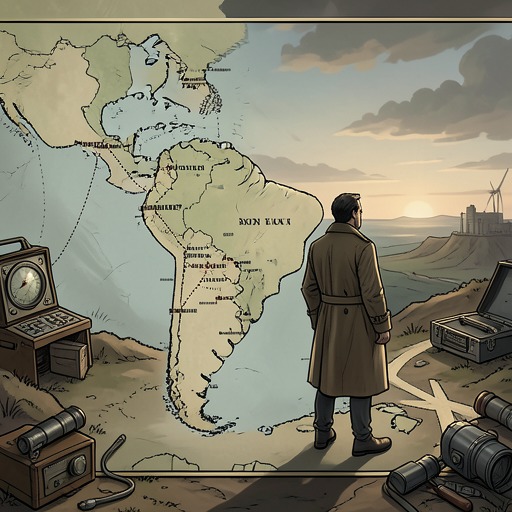
The Mengele Escape Myth
The Disappearance of Josef MengeleThe Mengele Escape Myth was the public image of Josef Mengele as a wealthy, elusive master of escape, supposedly ranging across continents and slipping unharmed from every pursuit. It grew from scattered reports, invented or embellished episodes, and the media skill of Simon Wiesenthal. Its force lay in a contradiction: the stories made Mengele seem almost omnipotent, while the account of his life depicts him as a fugitive whose actual whereabouts were concealed and whose daily existence narrowed into isolation.
The Fugitive Becomes a Legend
In the absence of effective action by governments constrained by realpolitik, journalists and Nazi hunters competed for a scoop, recognition, or money. Their reports built a figure likened to Goldfinger, a pop-cultural embodiment of evil who seemed rich, cunning, and impossible to catch. During the 1960s, when James Bond films were popular, Mengele’s name itself became a marketable symbol of Nazi criminality. The publicity made him an archetypal monster, and the repeated accounts of escape magnified the impression that he could survive any danger.
The stories circulated in strikingly different forms. A brief film showed a man in a T-shirt, reportedly using the name Dr Engwald, living near the border of Paraguay and Argentina and sailing a boat called the Viking on the Paraná River. Other reports placed Mengele on a farm near Altos with an attractive companion, dancing and attending social events; claimed he had undergone cosmetic surgery; or described him dining in Asunción and La Paz with Martin Bormann. A boatman said a bearded, taciturn man regularly crossed the Paraná, while a former bodyguard alleged that Mengele served as a doctor in the Paraguayan army’s northern logistical command. In May 1966, Brazilian police helped capture a man initially identified as Mengele, only for him to prove to be a German tourist. Two years later, another report claimed that an old policeman had shot Mengele aboard a boat and that he had drowned. These incompatible accounts did not settle his whereabouts; their recurrence made the uncertainty itself part of the legend.
Wiesenthal and the Media Story
Simon Wiesenthal became the central public figure associated with the pursuit. A survivor whose family had been murdered in the Holocaust, he began gathering information about Nazi war criminals after the war and founded the Jewish Documentation Centre in Vienna. His autobiography, I Hunted Eichmann, made him internationally famous by presenting his role in Eichmann’s capture as more decisive than it had been. The groundwork of Fritz Bauer remained less visible, while Mossad agents were bound by strict confidentiality. In contrast, Wiesenthal was publicly legible as a solitary, resourceful Nazi hunter: an engaging speaker in tweed jackets, surrounded by a concentration-camp map in his Viennese office and regularly receiving death threats.
After Eichmann’s trial and execution, Wiesenthal devoted much of his energy to tracking Mengele. His information network was failing, and he had little reliable knowledge of where the fugitive had gone. The stories he circulated therefore served two purposes: they sustained public interest in the search, and they insisted that the crimes of the Auschwitz doctor should not be forgotten. But the same publicity encouraged accounts whose drama exceeded their evidentiary basis. The legend was not simply a record of failed searches; it became a way of keeping an unresolved criminal case in public view.
The Elaborated Escapes
In 1967, Wiesenthal’s The Murderers Among Us devoted a chapter to Mengele, titled “The Man Who Collected Blue Eyes.” It recounted the story of a Mossad agent supposedly murdered in Bariloche and elaborated it into a dramatic encounter: a blonde spy, said to have been sterilized at Auschwitz, was recognized by Mengele through the tattoo on her arm while they danced, then killed during a mountain hike. The account gave the fugitive a chilling capacity to identify a former victim years later. Its narrative vividness, however, should not be confused with confirmation that the episode occurred as told.
Wiesenthal’s other accounts made Mengele a perpetual traveler. He was said to be hunted in Peru, Chile, Brazil, and remote Paraguayan army camps, surrounded by bodyguards, driving a powerful black Mercedes, and dining at the finest restaurants in Asunción. Another story sent him toward Egypt after Gamal Abdel Nasser supposedly refused him entry; Mengele and Martha then sailed to the Greek island of Kythnos. A hotel manager’s report that a German and his wife had left for an unknown destination supplied a narrow trace, which Wiesenthal rendered as another escape.
The tale of a planned raid by the Committee of Twelve, a group of Auschwitz survivors, added a near-capture set piece. In Wiesenthal’s account, the group arrived at the Hotel Tirol in Encarnación on a dark night in March 1964, only to find the room empty and its bedding still warm. Mengele was said to have been warned by telephone and to have fled into the jungle in his pajamas shortly before the searchers reached him. In this telling, each failed pursuit strengthened the same image: not merely a man who had escaped, but a fugitive endowed with uncanny foreknowledge.
The Hidden Man and the Imagined Stronghold
Wiesenthal’s book withheld its purportedly decisive revelation until the end: Mengele’s exact location in 1967. It placed him in a Paraguayan military zone between Puerto San Vincente on the Asunción–São Paulo highway and Fortress Carlos Antonio López on the Paraná River. The account described a small white hut in jungle landscaped by German immigrants, accessible by only two roads, both supposedly patrolled by soldiers and police ordered to stop cars and shoot anyone who disobeyed. Four armed guards with radios and walkie-talkies were said to watch over the house, paid for by Mengele himself. Such detail gave the fugitive a fortified domain and made concealment seem like a form of power.
The reality presented elsewhere in the account sharply undercuts that image. By September 1967, Mengele was fretting in his hiding place in Serra Negra, where he had remained since arriving five years earlier. Later, in his neighborhood, he lived under the name Pedro and had not left the area after imagining that someone on the subway had recognized him. He feared being identified and captured, while newspapers repeated stories of his supposed wealth and reach. The distance between the guarded jungle stronghold and the anxious, secluded fugitive exposes how the myth enlarged its subject beyond the life he was actually leading.
Recurrence, Doubt, and Consequence
The legend persisted into the 1980s, when renewed attention and competing claims again placed Mengele in Paraguay, Chile, Bolivia, Uruguay, the United States, or elsewhere in South America. By then Paraguay had revoked his citizenship, yet many still believed he remained protected there. In 1985, reports of his location multiplied as journalists and investigators returned to the search. At the exhumation in Embu das Artes, the discovery of remains associated with Wolfgang Gerhard did not immediately quiet suspicion. Simon Wiesenthal doubted the claim, recalling that Mengele had already been reported dead seven times, in places including Russia, Paraguay, Brazil, Bolivia, and Portugal.
The forensic examination proceeded through concrete comparisons: blood group, hair, fingerprints, bone measurements, the gap between the upper front teeth, vertebrae, femurs, a hole in the left cheekbone, and a prominent forehead. The investigators also consulted Mengele’s SS file, which recorded a pelvic fracture after a motorcycle accident at Auschwitz. These procedures stood in contrast to the myth’s dramatic escapes: they sought identification through material evidence rather than another anecdote about a vanishing fugitive. The family’s silence and the delayed disclosures kept doubts alive, but the inquiry showed how the search was shifting from imagined sightings toward examination of the remains.
The myth had a double consequence. By making Mengele a recurring figure in books, newspapers, and later popular culture, it helped keep attention on a criminal whom the public might otherwise have lost sight of. At the same time, each embellished escape turned uncertainty into spectacle and allowed the imagined fugitive to overshadow the limited, fearful life of the man being sought. Its lasting significance lies in that tension: publicity could resist forgetting, but the story of the invulnerable monster was not the same as reliable knowledge of his movements.